
DIFFICULY
★☆☆☆☆
2 hours 30 minutes
1-10 people
From
From ¥55,000 (tax included)
田んぼ, ウェルネス, 農業
OVERVIEW
Story: Spirit of the Soil
~ A former monk takes on "moving Zen." The path of the hoe (Kuwa) that awakens the earth ~
[Prologue: The Monk's Question]
The foothills of Akiruno, on the mountain side of Tokyo.
Greeting you in the gentle spring sunshine will be your guide, Nishikawa, dressed in a traditional Japanese work robe.
He was formerly a Buddhist monk and is also a bodywork therapist with a deep understanding of the human body.
"We are not tilling the soil. We are aligning our own bodies with the breath of the earth." His quiet words indicate that the time that is about to begin is not merely labor, but practice for the soul.
[Chapter 1: The Weight of Iron and the Awakening of the "Tanden"]
The item handed over is a traditional Japanese farming tool called a "kuwa" (hoe).
The heavy weight of the iron is reminiscent of the swords wielded by samurai in the past.
"Plowing the fields" is the process of aerating the soil that has been hardened and sealed during the winter.
If you try to do it using only your arm strength, you'll quickly run out of breath.
"Put your strength into your lower abdomen, below your navel (the dantian)." The instruction, from the perspective of a bodywork therapist, is based on body mechanics that are also found in ancient martial arts.
The moment the raised hoe falls due to gravity, I concentrate all my strength into a single point. *Stab.*
Along with the sound of the earth cracking, the scent of the earth rises into the air.
The rhythm of swinging the hoe mindlessly will eventually become "Zen in motion," clearing your mind.
[Chapter 2: The Mud Barrier Master]
After a time of rough and turbulent "movement," we move into a time of silence and stillness.
This is the process of "aze-nuri," which creates the outline of the rice paddy.
This is the process of creating a "vessel" that will not let a single drop of precious water leak out, and it is similar to building a "barrier" to protect a sacred area.
The mud is kneaded and then carefully applied and hardened using trowels and specialized tools.
What's required is the delicate touch of a plasterer and an aesthetic sense that allows for the creation of beautiful curves.
"God is in the details."
I learn about the Japanese spirit of micromanagement, which demands perfection even in something as simple as a mud wall, from the feel of the mud on my fingertips.
[Epilogue: A well-ordered land, a well-ordered heart]
When you finish work and thoroughly wash the mud off your tools, you feel a pleasant sense of fatigue.
What unfolds before your eyes is a rice field that has been reborn, tilled by your own hands and bordered by beautiful ridges.
This will be the unshakeable foundation for nurturing countless lives over the next six months.
"When the earth is in order, the mind will also be in order." The taste of tea enjoyed while being caressed by the breeze of the countryside is truly exceptional.
You didn't just dig in the dirt today.
I touched the spirit of the soil of Japan and became a part of its cycle.
"Spirit of the Soil" is a special program where participants experience farm work as a form of spiritual training, guided by a former Buddhist monk.
"Tatooshi" is the art of plowing rice fields, where a hoe (Kuwa), imbued with the spirit of a Japanese sword, is brought down upon the earth with the rhythm of martial arts.
And then there's the delicate "aze-nuri" technique, where mud is used to create a protective barrier.
The time spent in "moving Zen," where you face the earth with a clear mind, will harmonize your body and mind and invite you to delve into the spirit of nature worship that has been cherished by the Japanese people.


HIGHLIGHTS
Learn "Zen in Motion" through farm work from a former Buddhist monk instructor**
The instructor for this experience has a unique background, being both a former Buddhist monk and a nationally certified osteopath. He teaches not just farm work as mere labor, but a mindful time to connect with your own body and touch the soil with a clear mind. While feeling the energy of the earth, you can deeply learn about the spirit of nature worship (Animism) that the Japanese have cherished, both in words and practice.
Wielding the "Kuwa," a hoe that carries on the spirit of the Japanese sword: Martial arts-based body control**
In "Taokoshi," the traditional Japanese farming tool used to dig up the soil that has been dormant during the winter, we use the "Kuwa." The motion of swinging down the heavy Kuwa requires not just brute strength, but martial arts-based body control that focuses on the "Tanden," the center of the body. Using the Kuwa like a samurai wielding a sword, breathing air and life into the hard earth, is an experience that truly fuses fitness and spiritual discipline.
The Architecture of Mud: "Aze-nuri" (Rice Paddy Levee Plastering). The Japanese Micro-Management for Protecting Water**
In contrast to the boisterous plowing of rice paddies, "Aze-nuri," the plastering of rice paddy boundaries, requires the delicate touch of a plasterer. It involves plastering mud with trowels and special hoes to create a waterproof wall that doesn't allow a single drop of water to leak through. Experience the meticulous Japanese aesthetic sense of "God is in the details" and the traditional techniques for protecting "water," the lifeblood of rice, while enjoying it like playing in the mud.
ITINERARY
TOKYO Yamagawa Rice Farming Vol.1 Spirit of the Soil: The Awakening of the Earth and the Path of the "Kuwa" (Hoe)
Theme: "Destruction and Creation".
The martial arts-like physical manipulation to break up hard soil, and the delicate plastering techniques to protect against water damage.
[Detailed Time Schedule]
• 09:10 - 09:30
Reception/Changing (Meet & Greet)
◦ Location: Meet at the site (Itsukaichi area, Akiruno City) or at Musashi-Itsukaichi Station.
◦ Contents: Travel to the field and change into work clothes (rental work clothes, boots, etc.).
This is time to prepare yourself mentally.
• 09:30 - 10:00
Orientation & Body Mechanics Lecture
◦ Introduction: A philosophical explanation of "Why dig up the soil now?" by the instructor (a guide with qualifications as a former Buddhist monk and osteopath).
We will learn about the wisdom of "Kanden" farming, which involves allowing air to circulate through the soil that has been dormant during the winter, thereby activating microorganisms.
◦ Martial Arts Lecture: The hoe (Kuwa) is not merely a farming tool, but a tool made with the same materials (iron) and spirit as a Japanese sword. We will practice a stance that is mindful of the "Tanden" (lower abdomen), which is related to ancient martial arts, to avoid straining the lower back, and how to swing the hoe down.
• 10:00 - 10:50
Activity 1: Tilling (The Art of Tilling / TAOKOSHI)
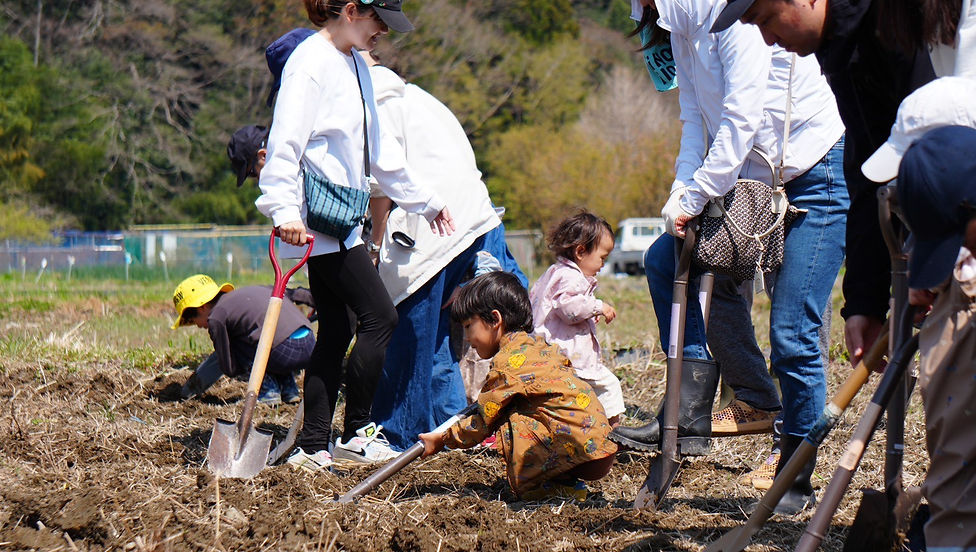
◦ Experience: Everyone lines up in a row and swings a hoe or shovel.
◦ Deep Culture Point:
▪ "Zen in motion": Immerse yourself in the rhythm of mindlessly breaking up the earth.
▪ The scent of soil: You can smell the bacteria and earth (petrichor) that rises the moment you dig it up.
▪ Collaboration: If one person falls behind, the line falls apart, so you will experience the importance of coordinating the breathing of the entire team.
◦ Explanation: This is the first important process, as rough tilling makes it easier to break down the soil in later stages.
• 10:50 - 11:00
Satoyama Tea Break
◦ Contents: Sit on the rice paddy embankment, rehydrate while feeling the breeze of Akiruno, and gaze at the rugged scenery of the freshly dug rice fields.
• 11:00 - 11:50
Activity 2: Ridge Plastering (AZE-NURI)
◦ Experience: This is a delicate task, in contrast to plowing. Mud is applied to the "aze" (ridges), which are the boundaries of the rice paddies, using a trowel or special hoe to create a waterproof layer. ◦ Deep Culture Point:
▪ "Plastering Skill": Meticulous work to ensure not a single drop of water leaks. This technique is also used in the plastering of walls in traditional Japanese architecture.
▪ Micro-management: Micro-management is so important that it's said, "The strength of the field ridges determines the autumn harvest." We'll learn about the Japanese attention to detail while having fun like playing in the mud.
The competition is a test of aesthetic sense, focusing on creating beautiful curves.
• 11:50 - 12:00
Tool maintenance and closing (Respect for Tools)
◦ Content: "Leave it more beautiful than you found it."
Wash off any mud from the hoe you used.
The session concludes with an action demonstrating gratitude for the tools used (Animism).
◦ Closing: We will conclude by building anticipation for the next "watering (puddling)" session.
DETAILS
[Tokyo Mountain Area Authentic Rice Paddy Experience Tour: Precautions, Clothing, and Items to Bring]
1. Regarding clothing
Since you'll be going into the rice paddies, it's essential to wear comfortable clothing that you don't mind getting dirty.
Please wear rubber boots and work gloves.
2. Packing List
Change of clothes, towel, drinks, rain gear (as work will be done even in light rain), hat.
3. Regarding costs
What's included in the tour price:
Participation fee
What is not included in the tour price:
Please cover transportation costs to the location, parking fees (1000 yen per day, payable in cash on-site), and personal drinks and snacks. Please also bring cash for shopping.
4. Response in case of rain
In principle, the event will proceed regardless of rain.
Rice field work needs to be carried out regardless of the weather.
However, if we determine that the event cannot be held due to severe weather such as a typhoon, we will contact you with an alternative date by the evening of the day before.
5. Other Notes
Safety management: Use shovels and hoes.
Please follow the guide's instructions and handle the equipment carefully to avoid injury.
Consideration for wildlife: Rice paddies are home to many living creatures.
Please participate with the spirit of Leave No Trace, treating nature with care.
6. Meeting place and contact information
Meeting place: Itsukaichi area, Akiruno City, Tokyo (a detailed map will be sent via email after registration).
For those traveling by train: 15-minute walk from JR Musashi-Itsukaichi Station.
For those arriving by car: You can use the nearby paid parking lot (1000 yen/day).
Organizer/Inquiries:
Tokyo Yamagawa DMC Co., Ltd.
(Email: info@fwness.com)
Get in touch with our team for quotes and advice,
including tour content not included on this site.